history
Building a Beacon
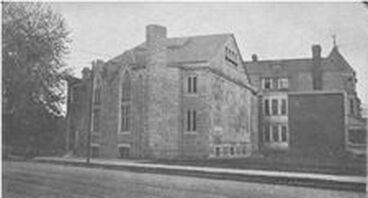 Completed in 1898, the original chapel and parsonage were demolished in 1905.
Calvary Methodist Episcopal Church was incorporated in 1895. A simple wooden chapel was erected on the southeast corner of 48th Street and Baltimore Avenue until the church could be built.
The initial church building was completed in 1898, but was demolished (along with the parsonage) in 1905 with new plans to erect a larger structure. Construction began in 1905, and was completed in 1907 - and the church was dedicated on November 24th of that year.
The resulting interior spaces include an acoustically outstanding sanctuary in a trapezoidal shape, and an intimate semi-circular chapel - an outstanding early example of the Akron Sunday School plan.
Also featuring a Brothers O’Dell organ, extensive original woodwork, scagliola columns, hand-painted murals, and a magnificent suite of leaded and stained glass windows and domes, the Calvary Church is home to the two largest signed Tiffany window ensembles in Philadelphia.
Click here for a more detailed history of the building.
The initial church building was completed in 1898, but was demolished (along with the parsonage) in 1905 with new plans to erect a larger structure. Construction began in 1905, and was completed in 1907 - and the church was dedicated on November 24th of that year.
The resulting interior spaces include an acoustically outstanding sanctuary in a trapezoidal shape, and an intimate semi-circular chapel - an outstanding early example of the Akron Sunday School plan.
Also featuring a Brothers O’Dell organ, extensive original woodwork, scagliola columns, hand-painted murals, and a magnificent suite of leaded and stained glass windows and domes, the Calvary Church is home to the two largest signed Tiffany window ensembles in Philadelphia.
Click here for a more detailed history of the building.
Light Grows Dim
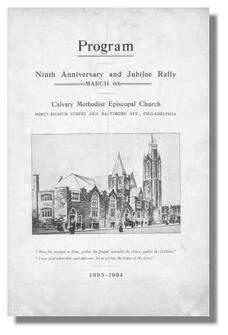 Never built, Dull's 1904 rendition
of the proposed church was showcased
on Calvary's ninth anniversary
Never built, Dull's 1904 rendition
of the proposed church was showcased
on Calvary's ninth anniversary
By 1994, the once grand Calvary building’s future couldn’t have looked more bleak. It shared the dishonor of being ranked by Philadelphia architects among the top ten endangered Delaware Valley landmarks in the Philadelphia Almanac. Radical change in the neighborhood’s demographics depleted original membership in many West Philadelphia churches.
With its declining membership, Calvary deferred maintenance projects for too long. Having never undergone a major renovation since its construction, Calvary now required major expenditures to return the building to a safe, functioning resource for the community.
In 1994, responding to the daunting costs and inability to sell the building in its current state, the Calvary congregation - in cooperation with the Eastern Pennsylvania Conference of the United Methodist Church - reluctantly put the building and its stained glass windows up for sale.
With its declining membership, Calvary deferred maintenance projects for too long. Having never undergone a major renovation since its construction, Calvary now required major expenditures to return the building to a safe, functioning resource for the community.
In 1994, responding to the daunting costs and inability to sell the building in its current state, the Calvary congregation - in cooperation with the Eastern Pennsylvania Conference of the United Methodist Church - reluctantly put the building and its stained glass windows up for sale.
Finding the Way
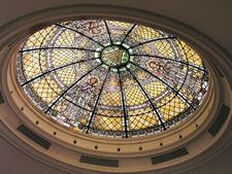 Stained glass dome, which crowns the chapel
As the two magnificent stained glass domes were being dismantled for shipping, community members formed a coalition to find a way to keep the doors open.
Reflecting on Calvary's legacy and longtime presence in the neighborhood, these dedicated community members - along with members of the congregation - founded the Calvary Center for Culture and Community (CCCC).
In 2000, after several years of hard work,” CCCC was incorporated as a separate 501(c)(3) organization. Its mission: To restore the building and redevelop it as a center for cultural and community activity. Supported entirely by community volunteers, including architects, educators, arts and financial administrators, local universities and religious leaders, the community hub at Calvary has grown beyond all expectations and become the unofficial town hall of the neighborhood and beyond.
Reflecting on Calvary's legacy and longtime presence in the neighborhood, these dedicated community members - along with members of the congregation - founded the Calvary Center for Culture and Community (CCCC).
In 2000, after several years of hard work,” CCCC was incorporated as a separate 501(c)(3) organization. Its mission: To restore the building and redevelop it as a center for cultural and community activity. Supported entirely by community volunteers, including architects, educators, arts and financial administrators, local universities and religious leaders, the community hub at Calvary has grown beyond all expectations and become the unofficial town hall of the neighborhood and beyond.